
MrFancyPanzer

1990

47

2

These are vernier calipers, very useful for measuring very accurately, at least to one tenth of a millimeter (about 4/1000s of an inch.
depending on the calipers. some quality ones can measure 1/100 mm, but I tend to take those measurements with a grain of salt, I prefer a micrometer for those.

The bits with the numbers and lines on the bottom jaw is called a vernier scale, thus the name vernier calipers. Notice how the numbers on the scale doesn't line up with any of the lines on the main scale, except the 0 and the 10. Since it is closed it means it's zero mm.

This one is also closed but the scales read 0.1mm, this is broken. Probably dropped on the floor, and now no longer accurate. Do not use.

This fine specimen is a Mitutoyo caliper, made in Japan. Good quality.

Now, here we see the zero lines up with the 20 mark. And none of the other lines match up. This means it's 20mm.

Here we see the zero line is slightly past the 20, but not quite to the 21 mm line on the main scale. What you need to do is find the number on the vernier scale that lines up with any of the lines on the main scale.
Here the 5 matches up with the 40mm line on the main scale, this means it's 20,5mm.

This 12mm endmill is 12mm, the zero right on the 12mm line.

Here on this machined part we see the zero is slightly behind the 20 line, but the 9 lines up with the 55mm line, this means it's 19,9mm.
My excuse for machining it undersize is that is one of the first things I turned on a lathe about 14 years ago.

The small jaws can also measure inside diameters. Tell me in the comments what you think the measurement is.

Sometimes they have info about thread tap drill sizes on the back. This one has metric and Whitworth, which is kind of novel. Whitworth hasn't been used in Europe for decades.

This plunger is used to measure depths of holes
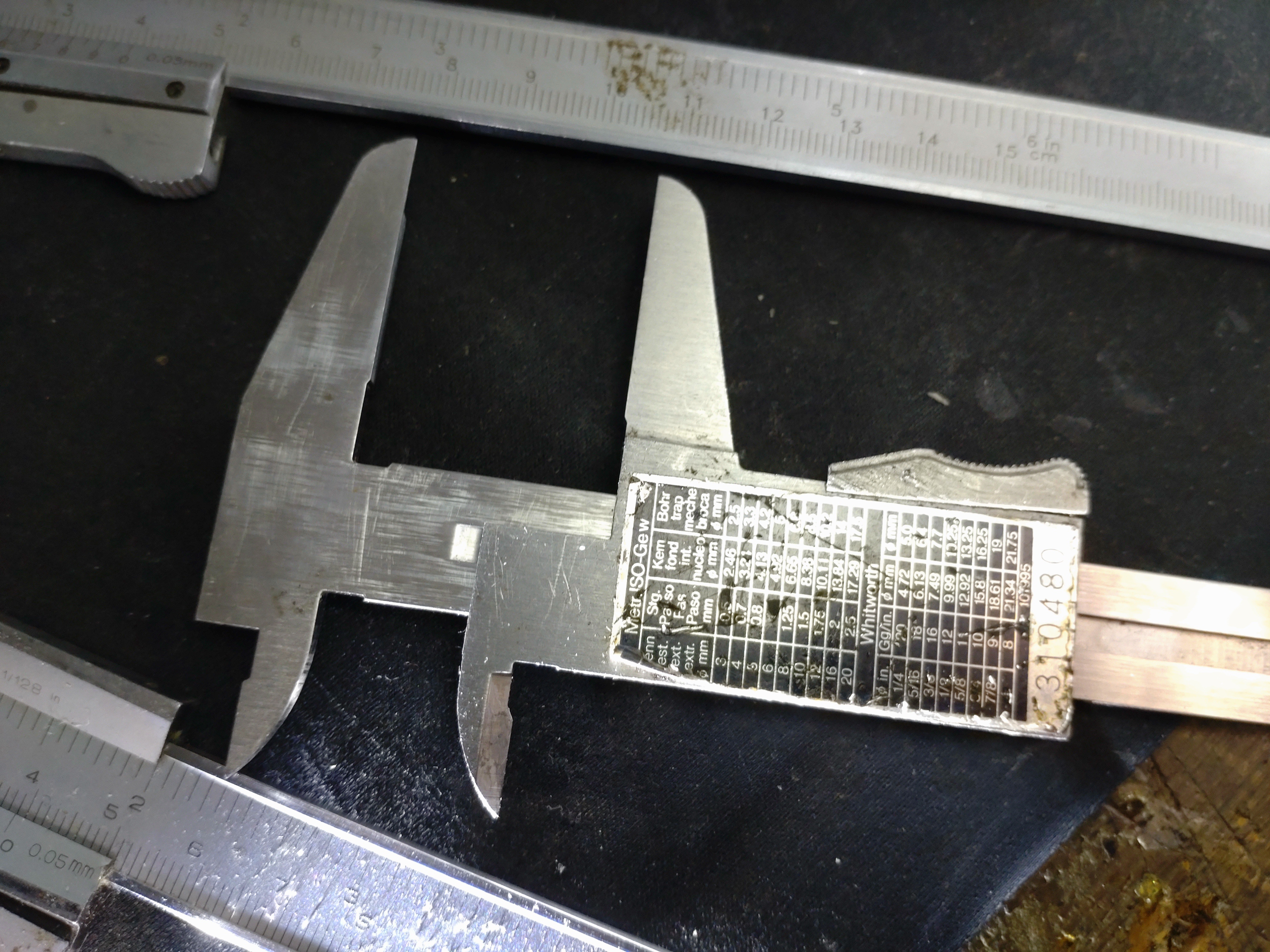
You can also use this shoulder on the back to measure steps.

Thusly

I hope this was informative to someone, and I hope I conveyed this info in a way that wasn't too confusing. I do love machining and like to share some knowledge. Smell ya later!

Cat tax!
UnitConversionBot
0.1mm ≈ 3.9 thousandths of an inch
relsky
That's cool as shit. I've only ever seen them used in youtube videos, so I had no idea how they worked. People are so clever.
Smidge204
Donaldbain
I measure things in metric the least, yes.
ScarecrowSticks
Wym metric is the only way to read calipers.
Canigetbannedagain2
I've only used vernier calipers with a dial gauge.
[deleted]
[deleted]
[deleted]
[deleted]
banjak
I hate the digital ones, always a dead battery when you need them most.
MrFancyPanzer
Yeah, ideally they should ideally have a solar panel like the calculators i used when i was a kid.
itsthejacket
12.2mm?
MrFancyPanzer
Yes indeed.
76000BatteryLlamas
12 1/5 mm
Volpe42
Very accurately is using a micrometer
MrFancyPanzer
Very accurate for the layman is not very accurate for the machinist.
spontaneous9
#9 10,2mm?
MrFancyPanzer
Not quite, you see the lines on the main scale are whole mm, it is two lines past 10 so 12mm, but the 2 on the vernier does line up with a line. you are exactly 2mm off.
CoretTrobane
To me it looks like the 0.15 lines up against the 18mm mark slightly better - I would say 12.15mm
MrFancyPanzer
That might be, parallax being a thing an all its a bit tricky to tell.
spontaneous9
Damn. I had just deleted my initial reply of 10,2 and changed my answer to 12,2, then I read your earlier reply that said my first response of 10,2 was accurate so I changed it back.
So my second guess was correct after all. Oh well. Thanks for an informative post, @OP! I have one of these hiding in a toolbox somewhere, which a friend had owned before he passed. Now I'll know how to read it.
MrFancyPanzer
Ah alright, that was a bit of a rollercoaster. i'm glad i could help.
crespomodesto
metric? (loud hissing sound)
theskirrid
Just you and Liberia buddy!
MrFancyPanzer
When are you foot fetishists finally going to learn decimal?
omgzwtfs
Learned metric after inheriting a mix of calipers, machinists rules, a Starrett micrometer, and hand-painted sign with conversions down to a micron from grandpa. Unfortunately the sign and micrometer were taken and sold by a cousin =/
MrFancyPanzer
micrometers can be a bit tricky. i was taught to measure with callipers first so i know roughly where i am on the scale.
crespomodesto