
soteksotek526

3177

44

3

[A U.S. Navy Grumman F9F-2 Panther of Fighter Squadron 112 (VF-112) "Fighting One Twelve" in flight. VF-112 was assigned to Carrier Air Group 11 (CVG-11) for four deployments to Korea aboard the aircraft carriers USS Valley Forge (CV-45) and USS Philippine Sea (CV-47) in 1950-1952.
Date between 1950 and 1952] The Grumman F9F Panther is one of the United States Navy's first successful carrier-based jet fighters, as well as Grumman’s first jet fighter. A single-engined, straight-winged day fighter, it was armed with four 20 mm (0.79 in) cannons and could carry a wide assortment of air-to-ground munitions.

The Panther was used extensively by the U.S. Navy and Marine Corps in the Korean War. It was also the first jet aircraft used by the Blue Angels aerobatics demonstration team, from 1949 through late 1954. The aircraft was exported to Argentina and was the first jet used by the Argentine Naval Aviation.
Total F9F production was 1,382. The design evolved into the swept wing Grumman F-9 Cougar.

Design and development [The XF9F-2 and XF9F-3 prototypes in 1948] Development studies at Grumman for jet-powered fighter aircraft began near the end of World War II as the first jet engines emerged. In a competition for a jet-powered night fighter for the United States Navy, on 3 April 1946 the Douglas F3D Skyknight was selected over Grumman's G-75, a two-seater powered by four Westinghouse J30s. The Navy's Bureau of Aeronautics (BuAer) also issued a contract to Grumman for two G-75 prototype aircraft on 11 April 1946, being given the Navy designation XF9F-1, in case the Skyknight ran into problems.
Grumman soon realized the G-75 was a dead end, but had been working on a completely different, single-engine day fighter, the G-79. In a bureaucratic maneuver, BuAer did not cancel the G-75 contract, but changed the wording to include three prototypes of the entirely different G-79. It became the Panther.
The prototype Panther, piloted by test pilot Corky Meyer, first flew on 21 November 1947. American engines available at the time included the Allison J33 and Westinghouse J34, but these were not considered sufficiently reliable, so the Navy specified the imported Rolls-Royce Nene turbojet, which was also more powerful, at 5,000 lb (2,300 kg) of thrust. Production aircraft would have a Nene, built under license by Pratt & Whitney as the J42. Since there was insufficient space within the wings and fuselage for fuel for the thirsty jet, permanently mounted wingtip fuel tanks were added, which incidentally improved the fighter's rate of roll.
The F9F was cleared for flight from aircraft carriers in September 1949. During the development phase, Grumman decided to change the Panther's engine, selecting the Pratt & Whitney J48-P-2, a license built version of the Rolls-Royce RB.44 Tay. The other engine that had been tested was the Allison J33-A-16. The armament was a quartet of 20mm guns, the Navy having already switched to this caliber (as opposed to the USAAF/USAF which continued to use .50 caliber M2/M3 guns). In addition, the Panther was soon armed with underwing air-to-ground rockets and up to 2,000 lb (910 kg) of bombs.

[An F9F-3 Panther fitted with an experimental Emerson turret housing four 12.7 mm machine guns, in 1950] From 1946, a swept-wing version was considered and after concerns about the Panther's inferiority to its MiG opponents in Korea, a conversion, known as Design 93, resulted in a swept-wing derivative, the F9F Cougar, which retained the Panther's designation number.
In 1949, the Panther was considered by the Australian government, as a possible locally-built replacement for the Mustang Mk 23 and De Havilland Vampire then operated by the Royal Australian Air Force (RAAF). The other designs considered initially were an Australian design, the CAC CA-23 (an unconventional, twin-jet all-weather fighter) and the Hawker P.1081. By mid-1950, however, RAAF Mustangs were in action in Korea and seen as highly vulnerable to the MiG-15. An immediately available stop-gap in the shape of the Gloster Meteor F.8 was operated by the RAAF in Korea from July 1951. (After its less-than-satisfactory performance against MiGs, the Meteor was replaced from 1954 by the CAC Sabre – an Australian-built, up-engined variant of the F-86.)

Operational history
US Navy [A Grumman F9F-2 Panther of fighter squadron VF-111 Sundowners, piloted by Lt JG Robert A. Guyer, dropping bombs over Korea. VF-111 was assigned to Air Task Group One (ATG-1) aboard the U.S. aircraft carrier USS Valley Forge (CV-45) to Korea from 15 October 1951 to 3 July 1952. Note the mission markers below the cockpit.
Date 1951/52] The Grumman Panther was the primary US Navy and USMC jet fighter and ground-attack aircraft in the Korean War. The Panther was the widest used Navy jet fighter of the war, flying 78,000 sorties. F9F-2s, F9F-3s and F9F-5s, as rugged attack aircraft, were able to sustain operations during intense anti-aircraft fire. The pilots also appreciated the air conditioned cockpit, a welcome change from the humid environment of piston-powered aircraft.
On 3 July 1950, Lieutenant, junior grade Leonard H. Plog, of VF-51, flying an F9F-3 scored the first US Navy air victory of the war by shooting down a propeller-powered Yak-9.
Despite their relatively low speed, Panther pilots also claimed seven Mikoyan-Gurevich MiG-15s, for the loss of two F9Fs. The first MiG-15 was downed on 9 November 1950, by Lieutenant Commander William (Bill) Amen of VF-111 flying an F9F-2B, during a UN Command attack on the Sinuiju bridges, near the mouth of the Yalu River. Two more MiG-15s were downed on 18 November 1950.
In a unique feat on 18 November 1952, Lt Royce Williams of VF-781, flying off USS Oriskany destroyed four MiGs, in one 35-minute encounter, during a series of air strikes against the North Korean port of Hoeryong. This combat is little-known due to the involvement of the US National Security Agency (NSA) – the existence of which was then top secret – in planning the mission; the MiGs were intercepted as a result of intelligence provided by the NSA. After losing contact with his wingman, Williams was alone in a dogfight with six MiG-15s; after landing on Oriskany, his Panther had 263 hits by cannon shells or fragments, and was beyond repair. Williams' victories were notable since the four MiGs were flown by Soviet Naval Aviation pilots: Russian sources confirmed Williams' claims, 40 years later, stating the pilots lost were Captains Belyakov and Vandalov, and Lieutenants Pakhomkin and Tarshinov.
Future astronaut Neil Armstrong flew the F9F extensively during the war, although he ejected from one of the aircraft after it was brought down by a wire strung across a valley in 1951. Future astronaut John Glenn and Boston Red Sox all-star baseball player Ted Williams also flew the F9F as Marine Corps pilots.
Panthers were withdrawn from front-line service in 1956, but remained in training roles and with U.S. Naval Air Reserve and U.S. Marine Air Reserve units until 1958. The Navy's Blue Angels flight demonstration team used the Panther for four years, beginning in 1951. The Panther was the Blue Angels' first jet. Some Panthers continued to serve in small numbers into the 1960s. From September 1962, surviving operational Panthers were designated F-9 within the new combined US tri-service designation system.

Argentine Navy [Argentine Panther attacks Army column during the 1963 Argentine Navy revolt] The only foreign buyer of the Panther was the Argentine Naval Aviation, which bought 28 ex-USN F9F-2B aircraft in 1957; the first 10 arrived in 1958. Only 24 aircraft were put in service, the rest were used as spares. The first flight of an Argentine Panther was in December 1958, and the last aircraft was put in service in January 1961.
The catapults on the then only Argentine carrier, ARA Independencia, were considered not powerful enough to launch the F9F, so the aircraft were land-based. However, in July 1963 a Panther (serial 0453/3-A-119) landed on Independencia as part of trials; becoming the first jet to land on an Argentine aircraft carrier.
Argentine Navy F9F-2 Panthers saw combat in the 1963 Argentine Navy Revolt, bombing and strafing a column of the Army 8th Tank Regiment which was advancing on the rebelling Punta Indio Naval Air Base. The attack destroyed several M4 Sherman tanks, at the cost of one F9F Panther shot down.
The Argentine Panthers were involved in the general mobilization during the 1965 border clash between Argentina and Chile but no combat occurred. They were taken out of service in 1969 due to the lack of spare parts and replaced with Douglas A-4Q Skyhawks.
The Argentine Navy also operated the F-9 Cougar.
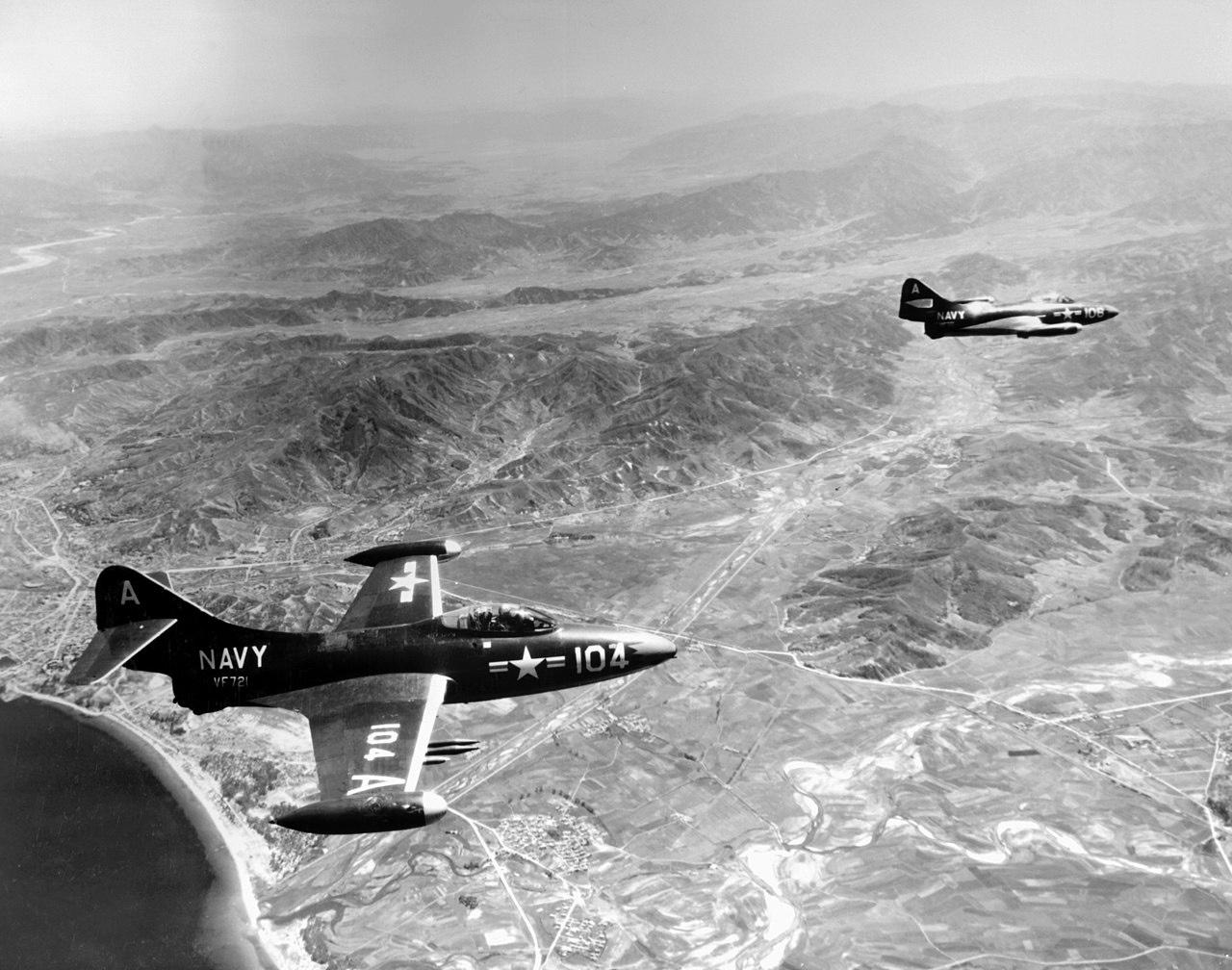
Variants [Two F9F-2Bs of VF-721 over Korea.]

[F9F-5s of VF-111 on USS Lake Champlain in 1953.]

[F9F-5P reconnaissance aircraft]

[F9F and AJ Savage of the NATC during in-flight refueling tests in 1953] XF9F-2
Prototypes, two built
F9F-2
First production version, powered by Pratt & Whitney J42 engine, 567 built.
F9F-2B
Version fitted with underwing racks for bombs and rockets. As all F9F-2s were brought up to this standard, the B designation was dropped.
F9F-2P
Unarmed photo-reconnaissance version used in Korea, 36 built.
XF9F-3
Prototype for the F9F-3, one built.
F9F-3
Allison J33 powered version produced as insurance against the failure of the J42, with all converted to the J42 later; redesignated F-9B in 1962, 54 built.
XF9F-4
Prototypes used in the development of the F9F-4, two built.
F9F-4
Version with longer fuselage with greater fuel load and powered by J33 engine. Most re-engined with J42s. F9F-4s were the first aircraft to successfully employ pressurized bleed air, tapped from the engine's compressor stages, and blown across the surface of the slot flaps, simulating a higher airspeed across the control surface, and thus achieving a decrease in stalling speed of 9 kn (17 km/h) for takeoff and 7 kn (13 km/h) on power approach for landing; re-designated F-9C in 1962, 109 ordered, all completed as F9F-5s.
F9F-5
Variant of F9F-4, but powered by Pratt & Whitney J48 engine, 616 built. Re-designated F-9D in 1962.
F9F-5P
Unarmed photo-reconnaissance version, with longer nose; redesignated RF-9D in 1962, 36 built.
F9F-5K
After the F9F Panther was withdrawn operational service, a number of F9F-5s were converted into unmanned target drone aircraft; redesignated QF-9D in 1962.
F9F-5KD
Radio controlled drone director conversions for F9F-5K drones; redesignated DF-9E in 1962.
Operators
Argentina
Argentine Navy - Argentine Naval Aviation
United States
United States Navy
United States Marine Corps
Surviving aircraft
Argentina
On display
F9F-2B
0421/3-A-106 (Argentine Navy) - Gate guardian at Puerto Belgrano Naval Base (Base Naval Puerto Belgrano - BNPB) at Bahía Blanca, Argentina.
0425/3-A-113 (Argentine Navy) - Being restored at Argentine Naval Aviation Museum (es:Museo de la Aviación Naval Argentina - MUAN) at Bahía Blanca, Argentina.
0452/3-A-111 (Argentine Navy) - Gate guardian at Punta Indio Naval Air Base (Base Aeronaval Punta Indio - BAPI) near La Plata, Argentina.
0453/3-A-118 (Argentine Navy) - Displayed at National Naval Museum (es:Museo Naval de la Nación) at Tigre, Argentina.

United States
Airworthy
F9F-2B [F9F-2B at the Cavanaugh Flight Museum] 123078 Cavanaugh Flight Museum in Addison, Texas.
On display
F9F-2
123050 - National Naval Aviation Museum at Naval Air Station Pensacola, Florida.
123557 - VFW Post 1621 in Janesville, Wisconsin.
123612 - NAS Oceana Air Park, Naval Air Station Oceana, Virginia.
123652 - Flying Leatherneck Aviation Museum, Marine Corps Air Station Miramar, California.
125183 - Pima Air & Space Museum, adjacent to Davis-Monthan AFB in Tucson, Arizona.
127120 - Wings of Freedom Aviation Museum at the former NAS JRB Willow Grove in Horsham, Pennsylvania.
F9F-2B
123526 - National Museum of the Marine Corps, adjacent to Marine Corps Base Quantico in Triangle, Virginia.
F9F-4
125180 - Lion's Park in Costa Mesa, California.
F9F-5
bureau number unknown (incorrectly marked as 141136) - USS Midway Museum in San Diego, California
125295 - Valiant Air Command Warbird Museum at Space Coast Regional Airport in Titusville, Florida.
125992 - Aviation Heritage Park in Bowling Green, KY.
126226 - Combat Air Museum adjacent to Forbes Air National Guard Base at Topeka Regional Airport / Forbes Field (former Forbes AFB) in Topeka, Kansas.
126275 - Battleship Memorial Park in Mobile, Alabama.
F9F-5P
126277 - The Air Museum, Planes of Fame, in Chino, California.
Under restoration or in storage
F9F-2
123054 - under restoration at Yanks Air Museum in Chino, California.
123092 - in storage for restoration at USS John F. Kennedy Museum in North Kingston, Rhode Island.
123420 - in storage at Fantasy of Flight in Polk City, Florida.
F9F-5
125467 - in storage by private owner in Bulverde, Texas.

Specifications (F9F-5 Panther) [F9F-5 line drawing] Data from United States Navy Aircraft since 1911
General characteristics
Crew: 1
Length: 38 ft 10 in (11.84 m)
Wingspan: 38 ft 0 in (11.58 m)
Height: 12 ft 3 in (3.73 m)
Wing area: 250 sq ft (23 m2)
Empty weight: 10,147 lb (4,603 kg)
Gross weight: 18,721 lb (8,492 kg)
Powerplant: 1 × Pratt & Whitney J48-P-6A turbojet, 6,250 lbf (27.8 kN) thrust
Performance
Maximum speed: 503 kn (579 mph, 932 km/h) at 5,000 ft (1,500 m)
Cruise speed: 418 kn (481 mph, 774 km/h)
Range: 1,100 nmi (1,300 mi, 2,100 km)
Service ceiling: 42,800 ft (13,000 m)
Rate of climb: 5,090 ft/min (25.9 m/s)
Armament
Guns: 4 × 20 mm (0.79 in) AN/M3 cannon, 760 rounds total
Hardpoints: 8 with a capacity of 3,465 lb (1,572 kg)
Notable appearances in media
Main article: Aircraft in fiction § F9F Panther https://en.wikipedia.org/wiki/Aircraft_in_fiction?wprov=sfti1
The F9F Panther was featured in the 1954 Korean War film The Bridges at Toko-Ri starring William Holden, Grace Kelly, Mickey Rooney and Fredric March, and in Men of the Fighting Lady starring Van Johnson, Walter Pidgeon and Keenan Wynn.
In the 1990 movie, The Hunt for Red October, footage of an F9F crashing into the fantail of the USS Midway (CV-41) is used in place of an F-14A, which crashes into the USS Enterprise (CVN-65).

Flying in a tight diamond formation, Gruman "Panthers" flown by pilot of Marine Fighter Squadron 115, roar over North Carolina waters in preparation for "open house" which will be held on Armed Forces Day, May 20. Visitors will have the opportunity to view these and many other type aircraft, both on the ground and in the air.
Date 30 March 1950

Explosion on the flight deck aboard U.S. Navy aircraft carrier USS Essex (CV-9) near the starboard bow, after a McDonnell F2H-2 Banshee (BuNo 124968) of Fighter Squadron VF-172 "Night Owls" crashed into parked aircraft in a deck landing accident off Korea on 16 September 1951. The accident resulted in the loss of seven lives and four aircraft: two F2H-2s (BuNo 124966, 124968) and two Grumman F9F-2 Panthers (Bureau No 125128, 125131) of VF-51 "Screaming Eagles". The F2H was piloted by LtJG Keller. The Essex, with assigned Carrier Air Group 5 (CVG-5), was deployed to Korea from 26 June 1951 to 25 March 1952.
Date 16 September 1951

US Navy Develops Refueling System for Carrier Planes in Flight. Successful development of an in-flight refueling system for carrier aircraft. Modeled after the British “Drogue and Probe” Method, the U.S. Navy’s in-flight refueling technique is accomplished when the pilot flies his aircraft, equipped with a refueling lance, into the probe device fastened at the end of the hose on a tanker aircraft. Various U.S. Navy carrier fighters are being equipped with refueling equipment. Tactical advantages to be gained by mid-air refueling are longer range offensive missions, combat air patrols for longer periods, and increased armament loads by fighter aircraft, carrying only minimum fuel at takeoff, and refueling in the air, en-route to targets. This AJ “Savage” modified for use as a “tanker” refuels a Grumman F9F “Panther” in evaluation tests at Naval Air Test Center, Patuxent River, Maryland, August 25, 1952.

Aircraft of U.S. Navy Untility Squadron 5 (VU-5) on display Naval Air Facility Naha, Okinawa (Japan), circa in January 1962. Visible are (clockwise from the front):
Ryan KDA Firebee drone;
Sikorsky HUS-1A Seahorse;
North American FJ-3D Fury;
Douglas JD-1 Invader;
Lockheed P2V-5FD Neptune;
Douglas AD-5T Skyraider;
Beechcraft SNB-5P Kansan;
Grumman F9F-5K Panther;
North American FJ-4 Fury;
Vought F8U-1D Crusader.
Date circa January 1962

U.S. Navy crewmen servicing Grumman F9F-2 Panthers (BuNo 123078 in front) of Fighter Squadron VF-151 "Black Knights" aboard the aircraft carrier USS Boxer (CVA-21). VF-151 was assigned to Air Task Group 1 (ATG-1) abord the Boxer for a deployment to Korea and the Western Pacific from 30 March to 28 November 1953.
Date 1953

Lt(JG) Hugh N. Batten from Fighter Squadron 91 (VF-91) "Red Lightnings" lands his damaged Grumman F9F-2 Panther (BuNo 123615) aboard the U.S. Navy aircraft carrier USS Philippine Sea (CVA-47) after it was hit by enemy anti-aircraft fire on 12 July 1953. The plane's nose covering has been entirely torn away. VF-91 was assigned to Carrier Air Group 9 (CVG-9) aboard the Philippine Sea for a deployment to the Western Pacific and Korea from 15 December 1952 to 14 August 1953.
Date 12 July 1953

Mascot dog "Beno" sits in a U.S. Navy Grumman F9F-2 Panther of Fighter Squadron 31 (VF-31) "Tomcatters" aboard the aircraft carrier USS Leyte (CV-32), on 3 February 1950. VF-31 was assigned to Carrier Air Group 3 (CVG-3) aboard the Leyte for a deployment to Korea from 6 September 1950 to 3 February 1951.
Date 3 February 1951

Damage to plane and pilot after combat. USS Philippine Sea (CV-47)
Date 17 September 1950

Four U.S. Navy aircraft assigned to the Naval Air Test Center at Naval Air Station Patuxent River, Maryland (USA), in flight (front to back):
Vought F7U-1 Cutlass, BuNo 124415 (this aircraft made its first flight on 1 March 1950);
McDonnell F2H-2 Banshee, BuNo 123222;
Grumman F9F-2 Panther, BuNo 123018; and
Vought F6U-1 Pirate, BuNo 122481.
Date circa 1950

U.S. Navy Grumman F9F-2 Panther fighters of fighter squadron VF-93 Blue Blazers being launched for a mission over Korea from the aircraft carrier USS Philippine Sea (CV-47). VF-93 was assigned to Carrier Air Group 9 (CVG-9) for a deployement to Korea and the Western Pacific from 15 December 1952 to 14 August 1953.
Date circa 1952-1953

Three U.S. Navy Grumman F9F-2P/-5P Panther of Composite Squuadron VC-61 "Eyes of the Fleet" in flight over Naval Air Station North Island and Point Loma, California (USA).
Date 1950s

Series of photos of a ramp strike of a U.S. Navy Grumman F9F-2 Panther from the Naval Air Test Center aboard the aircraft carrier USS Midway (CVB-41) on 23 July 1951. Fortunately, on impact the cockpit section separated from the plane's fuselage and rolled forward on the flight deck saving the pilot, Cdr. George C. Duncan, from the fire. He only suffered minor injuries.
Date 23 July 1951

A U.S. Marine Corps Grumman F9F-2 Panther attacks a ground target in Korea which was marked by a U.S. Air Force North American T-6G Mosquito Forward Air Control aircraft of the 6147th Tactical Control Group.
Original caption: "OVER NORTH KOREA--This photo shows the path of a high-velocity rocket from the point of its release to within a few feet of its target. An F-9F "Pantherjet" of the 1st Marine Air Wing, was summoned to the area by a T-6 "Mosquito" observation craft of the 6147th Tactical Control Group. The target, was effectively neutralized by strikes such as the "Pantherjet" is making.: ca. 08/1951"
Date circa August 1951

Photographer
Lieutenant (Junior Grade) George Elmies, Composite Squadron 61 (VC-61)
Description
English: Two U.S. Navy Grumman F9F-2 Panther (left: BuNo 123583) from Fighter Squadron 191 (VF-191) "Satan's Kittens" dump fuel as they fly past the aircraft carrier USS Princeton (CV-37), during Korean War operations, circa in May 1951. VF-191 was assigned to Carrier Air Group 19 (CVG-19) aboard the Princeton for a deployment to Korea from 9 November 1950 to 29 May 1951.
Date circa May 1951

Two U.S. Navy Grumman F9F-2 Panther jets from Fighter Squadron 51 (VF-51) "Screaming Eagles" during a sortie over Korea, in 1951-52. VF-51 was assigned to Carrier Air Group 5 (CVG-5) aboard the aircraft carrier USS Essex (CV-9) for a deployment to Korea from 26 June 1951 to 25 March 1952.
The pilot of the lead plane ("S-107") was Lt.JG George Russell, "S-116" was flown by Ens. Neil Armstrong.
Date between 1951 and 1952

Three U.S. Navy Grumman F9F-2 Panther fighters of fighter squadron VF-123 The Blue Racers over Mt. Fuji, Japan, in 1955. VF-123 was assigned to Air Task Group 2 (ATG-2) aboard the aircraft carrier USS Philippine Sea (CVA-47) for a deployment to the Western Pacific from 1 April to 23 November 1955. VF-123 was redesignated VF-53 in 1958 and VF-143 Pukin Dogs in 1962.
Date 1955

A U.S. Navy Grumman F9F-5 Panther (BuNo 126066) in flight in front of a snow capped volcano. The aircraft is the personal aircraft of the Commander, Carrier Air Group 2. The photo was probably taken in 1953-54 when fighter squadrons VF-63 "Fighting Redcocks" and VF-64 "Free Lancers" flying F9F-5s were assigned to CVG-2 for a deployment to the Western Pacific aboard the aircraft carrier USS Yorktown (CVA-10).
Date circa 1954

U.S. Navy Grumman F9F-5 Panthers from Fighter Squadrons VF-112 "Fighting Twelve" (V-2XX) and VF-113 "Stingers" (V-3XX) aboard the aircraft carrier USS Kearsarge (CVA-33). Both squadrons were assigned to Carrier Air Group 11 (CVG-11) aboard the Kearsarge for a deplyoment to the Western Pacific from 1 July 1953 to 18 January 1954.
Date circa 1953

Grumman DF-9E Panther 126977 wearing the drone director markings scheme when operated by VU-1 Fleet Utility Squadron, shortly after retirement. Preserved at Planes of Fame, Ontario CA.
Date 18 October 1970

A photograph showing the bombing of a bridge in Korea, in November 1952. A U.S. Navy Grumman F9F-2 Panther of Fighter Squadron 71 (VF-71), piloted by Lt. R.P. Yeatman, has just fired the HVAR rockets under the wings (hence the smoke) and also dropped the left 113 kg (250 lb) bomb, visible just to the right of the center of the bridge. VF-71 was assigned to Carrier Air Group Seven (CVG-7) aboard the aircraft carrier USS Bon Homme Richard (CVA-31) for a deployment to Korea from 20 May 1952 to 8 January 1953. VF-71 had the tail code "L-1XX" during that deployment.
Date November 1952

Maintenance on a Pratt & Whitney J48-P-6A engine of a U.S. Navy Grumman F9F Panther of advanced training unit ATU-201 at Naval air Station Corpus Christi, Texas (USA), in 1957.
Date 1957

A U.S. Air Force Boeing SB-29 Super Dumbo (s/n 44-70128) in flight with a U.S. Navy Grumman F9F-5P Panther from Composite Squadron VC-61 Det.F Eyes of the Fleet. VC-61 Det.F was assigned to Carrier Air Group 14 (CVG-14) aboard the aircraft Carrier USS Boxer (CVA-21) for a deployment to the Western Pacfic from 3 June 1955 to 3 February 1956.
Date circa 1955

Grumman F9F-5 Panther fighters of the U.S. Navy Blue Angels aerobatic team fly in formation over Naval Air Station Jacksonville, Florida (USA), on 9 January 1954. Three of the four planes are BuNos 125258, 125294 and 125305.
Date 9 January 1954

Two Grumman F9F Panther prototypes in flight in 1948. The aircraft closer to the camera is the XF9F-3 (BuNo 122476), having an Allison J33-A-8 engine, the further plane is a XF9F-2, powered by a Pratt & Whitney J42-P-6 engine (a licence-built Rolls-Royce Nene).
Date 1948

A U.S. Navy Grumman F9F-3 Panther (BuNo 122562) operated by the Naval Air Test Center at Patuxent River, Maryland (USA). This aircraft was fitted with an experimental electro-hydraulically driven Emerson Aero X17A roll-traverse turret housing four 12.7 mm machine guns, in 1950. The idea was that the aircraft could destroy enemy bombers while avoiding the fire of the tail gunner. The guns could be directed at any angle from directly forward to 20 degrees aft, and the gun mount could roll 360 degrees. The roll rate was 100 degrees per second, and the guns could be traversed at up to 200 degrees per second. Unfortunately, the volume required for the fire control system avionics, and the sheer weight of the turret, made it impractical for single-seat fighters and the program was cancelled in early 1954.
Date between 1950 and 1954

A Grumman F9F-5 Panther of the Argentine Navy attacks Argentine Army's 8th Tank Regiment. During the Argentine Navy Revolt in 1963, the 8th Tank Regiment was mobilized to seize the naval base at Punta Indio. Under the orders of base commander Captain Santiago Sabarots, Argentine Navy F9F Panthers, AT-6 Texans and F4U Corsairs bombed the advancing column, destroying a dozen M4 Sherman tanks.
Русский: Мятежная «Пантера» атакует расположение 8-го бронетанкового полка
Date circa 2 April 1963
Source Журнал «Авиация и время» ("Aviation and Time"), № 6, 2011, стр. 26

Two U.S. Navy Grumman F9F-2B Panther of Fighter Squadron 721 (VF-721) "Starbusters" flying over Wonsan and heading for Togwon, Korea, on 15 July 1951. VF-721 was assigned to Carrier Air Group 101 (CVG-101) aboard the aircraft USS Boxer (CV-21) for a deployment to Korea from 2 March to 24 October 1951.
Date 15 July 1951

Grumman F9F-5 Panthers of fighter squadron VF-111 Sundowners on the flight deck of the aircraft carrier USS Lake Champlain (CVA-39), Hong Kong harbour, 1953. VF-111 was assigned to Carrier Air Group Four (CVG-4) during the deployment to Korea and the Western Pacific from 30 Jun 1953 to 04 Dec 1953.
UnitConversionBot
20 mm ≈ 790 thousandths of an inch
HughIsmac
Great pictures. Love them all!
InoffensivePablum
My grandfather was a carrier mechanic in WWII. He would go on to be on the crew that transitioned the Blue Angels from props to the Panther.
soteksotek526
Love your anecdote. Thank you for sharing.
immoralbeast
Not the Hellcat but I still appreciate you
soteksotek526
I’ve already done the hellcat.
soteksotek526
7 posts back
Volpe42
Made by the same company that made the LLV
BaloneyBob
Oven on wheels. I hated that vehicle.
Volpe42
Metris has its own problems. Mine keeps having light boards die every month or so.