
pomax

1751

24

3

We recently bought a drive motor for our pasta machine. It's basically just a $50 electro-motor with two speeds that clicks into any of many makes of pasta machines as long as they have bayonet fittings around the hole you normally put the crank handle in, and it makes "making fresh pasta" basically a matter of whim rather than planning.
It was 2pm on a weekday, lasagna for dinner seemed like a good idea: let's do this thing.

First up, making lasagna sheets. There's nothing terribly difficult about making pasta, it's just a boring amount of work if you do it by hand. And the drive motor solves that problem pretty much entirely.
This is the yield of 300g durum flour, 3 eggs, and a little bit of salt, mixed into a fairly hard dough, left to rest for about an hour, then cut into four chunks and run through the pasta machine.
Each chunk was first rolled out like a sausage and squished flat, then run through the machine at setting 1 a few times to soften up the dough (the first pass will be ragged af, so you run it through, fold it double, press it down a little, run it through the machine again, for as many times until it starts to feel soft and workable).
After that, we ran it through 2 and 3, then folded it "like a tie", which is basically take both sides of the long strip of pasta, and fold them over to the center. press down, then roll through the same setting of the machine: congratulations, you now have a reasonably straight-sided thin strip of pasta.
This was then run through settings 4 and 5, at which point it got cut to useful size strips, and left to dry a bit.

Next up, sauce. No vegans or vegetarians in our household, but someone does have a condition that makes it impossible for them to eat most mammalian meats, so: nothing wrong a chicken bolognese. Step one would be to make some chicken sausage meat out of thigh, garlic, onion, paprika, thyme, basil and black pepper. Mince in the food processor (you want your chicken to be chilled for this, not at room temperature), and we're ready to turn that into a bolognese.

Nothing too complicated here:
- Fry minced chicken to get some nice browning going. Things will stick to the pan. That's a good thing. And because the dietary problem is really just "the meat", I fried the chicken in tallow, because it's delicious.
- Once nicely browned, "deglaze" the pan with some wine to dissolve all that delicious crustiness and get it back into the food.
- Add in soffritto, which is chopped onion, carrot, and celery. Except I don't particularly care for celery so I left it out. That gets to simmer a little bit, after which we add a can of tomatoes and the same can's worth of water.
- Then we set this to low heat and don't touch it for 3 hours.
I mean it's still a work day, so far we've pretty much just spent the lunch break making this stuff and we'll be back later.

After many hours of "it's starting to smell really good here", the bolognese has reduced from "watery" to "deliciously saucy" and it's time to make a bechamel. This means making roux, which is pretty damn easy: one to one weights of melted butter and flour, melting the butter first and then adding in the flour while stirring. Once mixed, keep stirring it over medium heat to bring out some colour, and then put it in a bowl because you made way too much. Which is fine because it'll keep for months in the freezer if properly packed. Press it into an ice cube tray, freeze, then pack the cubes in a freezer bag and you'll have conveniently portioned roux for any next recipe that calls for thickening.
Anyway, mix about 100g roux with 1L of milk (how fatty you want that milk to be is up to you - I actually used skimmed milk because there was enough fat in the rest of the dish already), add some ground nutmeg, some salt, and some fresh ground black pepper, and stir over medium heat until it starts to thicken. Much like custard, for the longest time it'll seem like nothing's happening and then all of a sudden it'll start to thicken up. Turn off the heat, keep stirring while it loses some of its heat and then set that aside because we're ready to make this thing.

I started the lasagna with a little bit of bechamel at the bottom before placing the first layer of pasta, mostly because the absolute worst is when your lasagna has unexposed pasta that bakes into a rock hard, tooth shattering material.
Then it's a fairly straight forward process: sheets of pasta, some bechamel, some bolognese, repeat. But of course it's your lasagna so if you want to layer in more: make it happen. We had a big box of spinach and a log of cheddar in the fridge, so... in they go.

Big handful of spinach leaves, some not-too-thick slices of cheddar, and on to the next layer!

Four layers in, we've reached the maximum lasagna capacity for this dish.
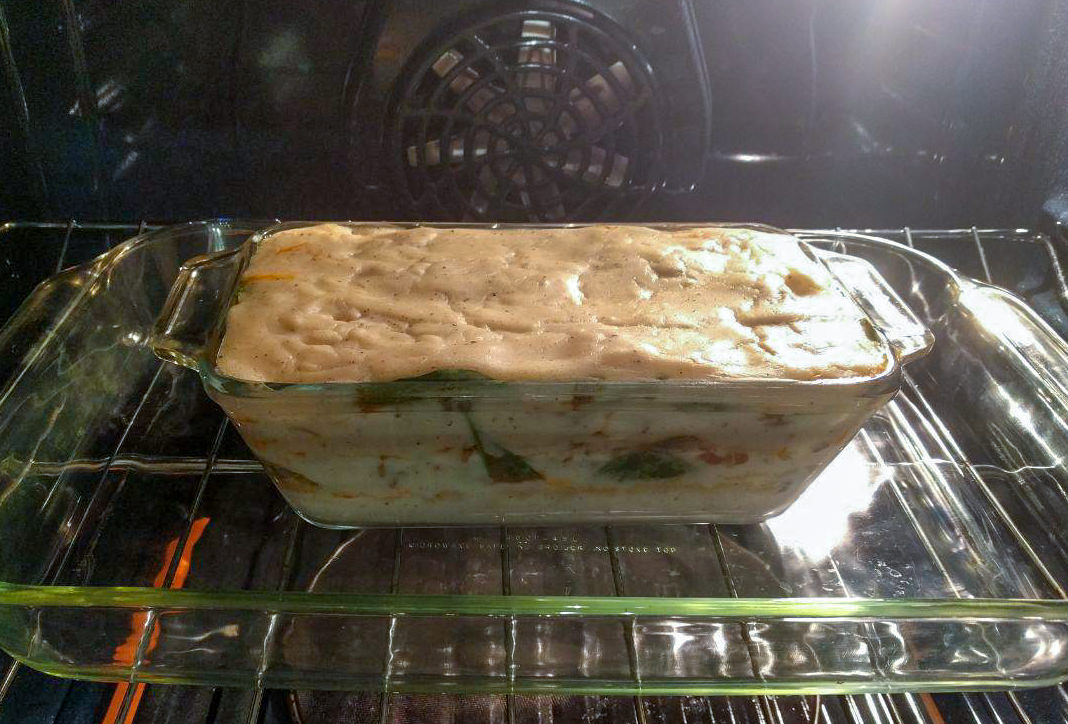
The final top layer is just pasta with bechamel on top, which will bake to a beautiful golden "crust" while still having a creamy texture.
For this size we stuck it in the oven at 350F/180C for an hour, in a bigger dish to make sure we catch any possible drippage.

Success! Only a minor amount of drippage occurred. And that top layer looks amazing.

And the final result, which is a typical example of how much lasagna is way too chill to wait for you to take a photograph before succumbing to gravity.
Gegenschein
Should have marked this as Mature. Way too sexy
pomax
Then again, wouldn't want to deprive anyone.
gnagni
Don't call it lasagna please, it hurts me. 'Layered stratification of edible things" is more suitable.
funone77
Definitely a legitimate interpretation of lasagna imo.
pomax
Heya! Nope, I will keep calling it actually what it is.
gnagni
Well, ok then
KnightofNoLyfe
You can't let him insult your pride like that. Get back up and give it to him!