
deadcardgamesarethebest

862

6

2

Legend of The Burning Sands was a sister card game to L5R produced by Fiverings Publishing and AEG in 1998. The game (as with most AEG card games) played using similar rules to that of L5R with some bespoke deviations that made the game unique. Where L5R was a game about Honor and Samurai families, LBS was a game about court intrigue and influence in the Holy City of Medinaat al-Salaam.

Much like L5R, LBS had the same system of personalities with keywords, holdings for producing currency (copper in this game) and an action set up that functioned on a back and fourth approach throughout the game turn. There were Champions, just like in L5R, and over time characters would gain experience and perhaps even leave their home faction and join other factions!
There were 12 factions in the game by the time the final set, awakening released in 1999. They were The Ashalan, Ivory Kingdoms, Assassins, Ra'Shari, Senpet, Yodatai, Celestial Alliance, Jackals, Ebonites, Moto, Dahab and Qabal. Each group represented a specific culture or sub-culture that could be found in, or near the burning sands. The Ivory Kingdoms were based off Indian culture, where the Ra'Shari were based off of nomadic Gypsy peoples, now known as the Romani of today. The Ashalan were a sort of Alien faction from the stars, where the Senpet were of Ancient Egyptian origins. The Yodatai were a stand-in for the Roman Empire and the Moto were the nomadic horsemen of the grasslands. Just as in L5R players would identify with one of the factions and play out story events which would determine the major stories' progression. There were even factions and characters from L5R who made an appearance!

The two main and unique concepts of LBS were City Districts, which contained one of your resources, water. The other was the honor stat from L5R being replaced with the Influence stat. Water was key, you needed it to cast and hire personalities, but it also absorbed damage during attacks and could even be raided during the "Night" phase of the turn. Run out of water, and it's game over! Sadly, the influence stat never really saw much use. There were only four sets of LBS.

Your stronghold would give you a number of city points which you would use to buy districts at the start of the game. These districts would further give you abilities and would provide you with one of the game's critical resources, water. If you lost all of your districts, you lost the game. This was a military victory. Some factions have very specific and unique city sections that only they could purchase.

Just as with L5R characters might start out as simple warriors or soldiers or even Sahir (wizards) but over the course of the story they might see themselves gain experience, evolve or even die!
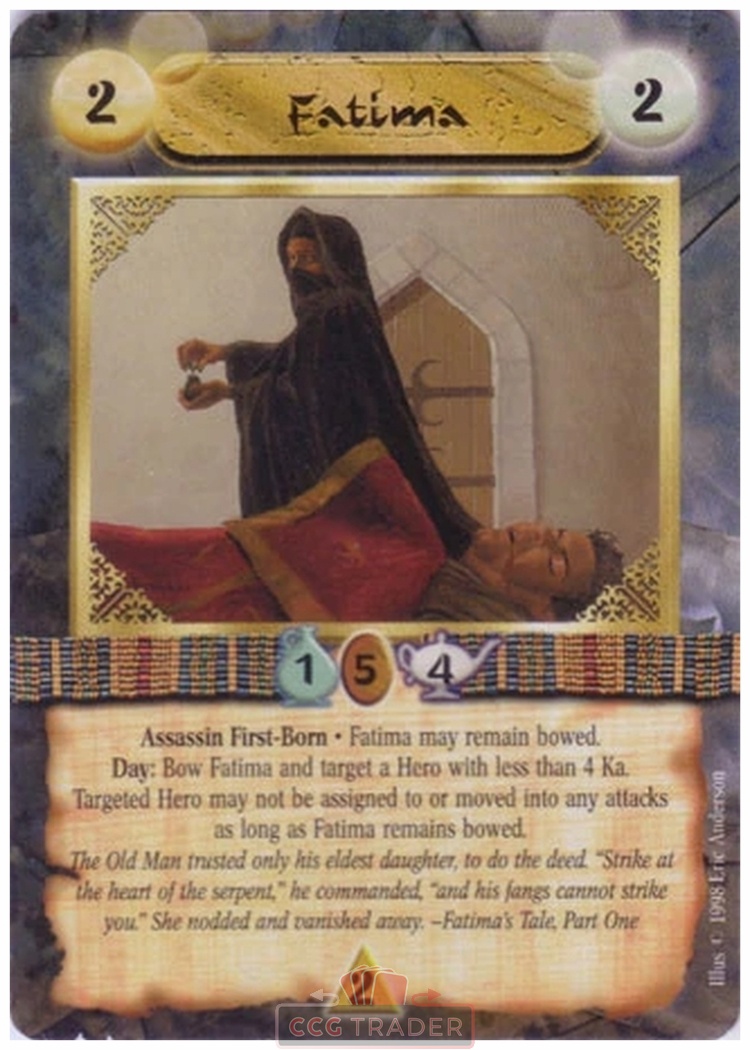
One of the most popular factions in the game were the Assassins. Almost all of the personalities were female assassins who centered around a dueling strategy. Early dueling decks were very hard to play, but the player base saw this challenge as a way to enhance the game, not as a detriment.

While there were of course spells to cast in game, another unique feature of the game was the focus on using Sahir to summon Djinn. These powerful personalities couldn't be played the normal way and had to be summoned into the game. Later on, the Djinn would become their own faction, the Celestial Alliance which would be one of the most popular factions in the games short history.

There were many types of Djinn throughout the four sets and some players would design decks specifically to play as many Djinn as possible. One of the factions, the Senpet were very good at this strategy as they had a lot of Sahir in their faction, perfect for summoning these elusive creatures.

As stated above dueling was a huge part of the game, knife fights that evoked the same kind of imagery as seen in Dune which was inspired by the legends and stories of the real life middle east were common in game. Honor, while not quite as important as in L5R was still a major component of the game.
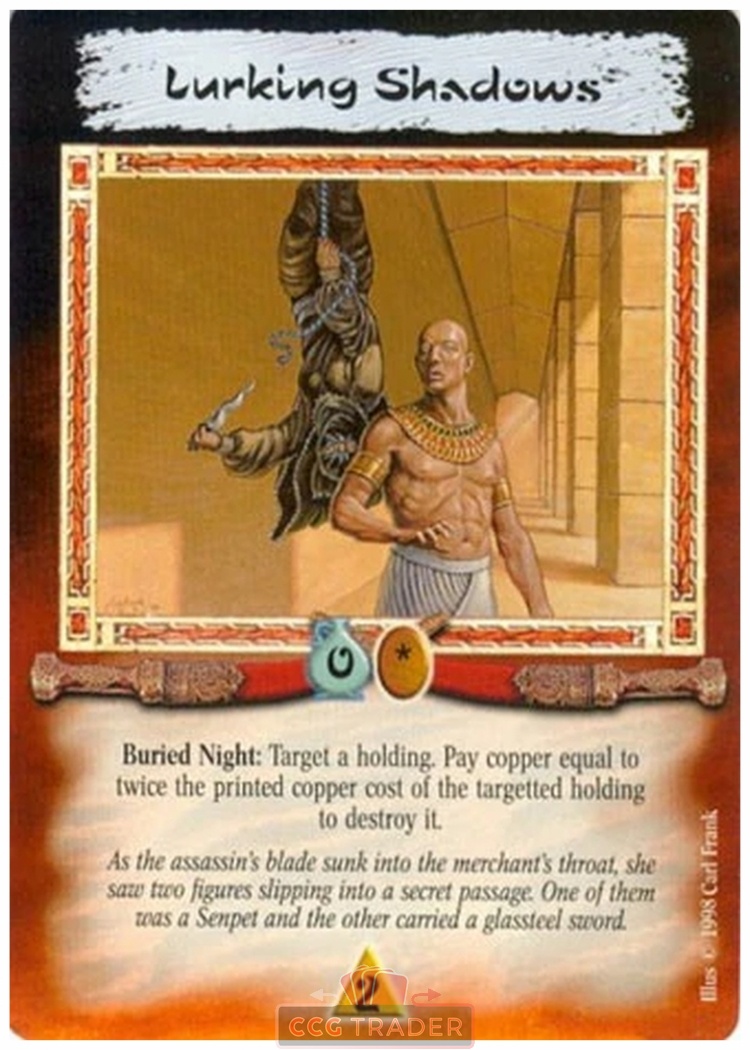
One interesting aspect of the game is that unlike L5R, LBS made use of only one 60 card deck, instead of 2 40 card decks. But LBS has two distinct discard piles, one in which cards were buried (essentially removed from the game after use) and one in which cards were discarded and could be recycled when you ran out of cards to draw. Other unique aspects of the game centered around Day actions and Night actions which corresponded to the same named phases. Each turn represented one 24 hour period of time, with a set day and night cycle which saw action timing and usage become a significant part of the game.

Where L5R had the Five Rings, LBS made use of the 1000 tales. Stories which you could play, and after collecting enough stories you would win the game. This mechanic was an attempt to copy the Tale of the 1001 Arabian Nights. The Character of Selqet, was actually Bayushi Kachiko, of the Scorpion Clan from L5R. Their entire clan had been banished to the burning sands for a time after their attempt to take control of the empire through a Coup.

The amount of cross play between L5R and LBS was very high. The Moto would eventually become a part of L5R's Unicorn Clan, where as for a time members of the Lion Clan and Scorpion clans would see themselves banished to the area.
Sadly LBS came out at a time when the company was experimenting with a new release system called Rolling Thunder. Small sets of cards released every two months. This system wasn't very popular and was extremely hard to keep on schedule. It was abandoned after only a year and a half of trying, and LBS went along with it.
In my next post I'll continue down the rabbit hole of AEG games with another of my favorites. 7th Sea, a game of high seas adventure and swashbuckling and the only AEG game not set in their own home universe!
Until next time, happy gaming!
dougCheesedog
LBS was a brilliant but doomed system. Too many games, too complicated to master, and as you noted, a terrible distribution system. I still have some lurking about the house, though.
deadcardgamesarethebest
Rolling Thunder was pushed by WOTC who had control at the time over FiveRings Publishing. It was a nifty idea but in practice it wasn't sustainable. I really wish the game could have had a few years to cook, I suspect it would have been something truly special.