
henryv1598

1168

42

0

This is the 12.5 inch f/5 Newtonian Reflector in the Observatory of the Houston Astronomical Society. It's one of three telescopes in the observatory. It was built by club members in the 70's and is an excellent optical instrument.
I'm one of the few people who the Observatory Director feels comfortable with cleaning and maintaining the scope. I took these pics last year when I was asked to clean it as a few members were complaining that the mirrors were dirty.

This is the aft-end of the tube after the mirror cell was removed.
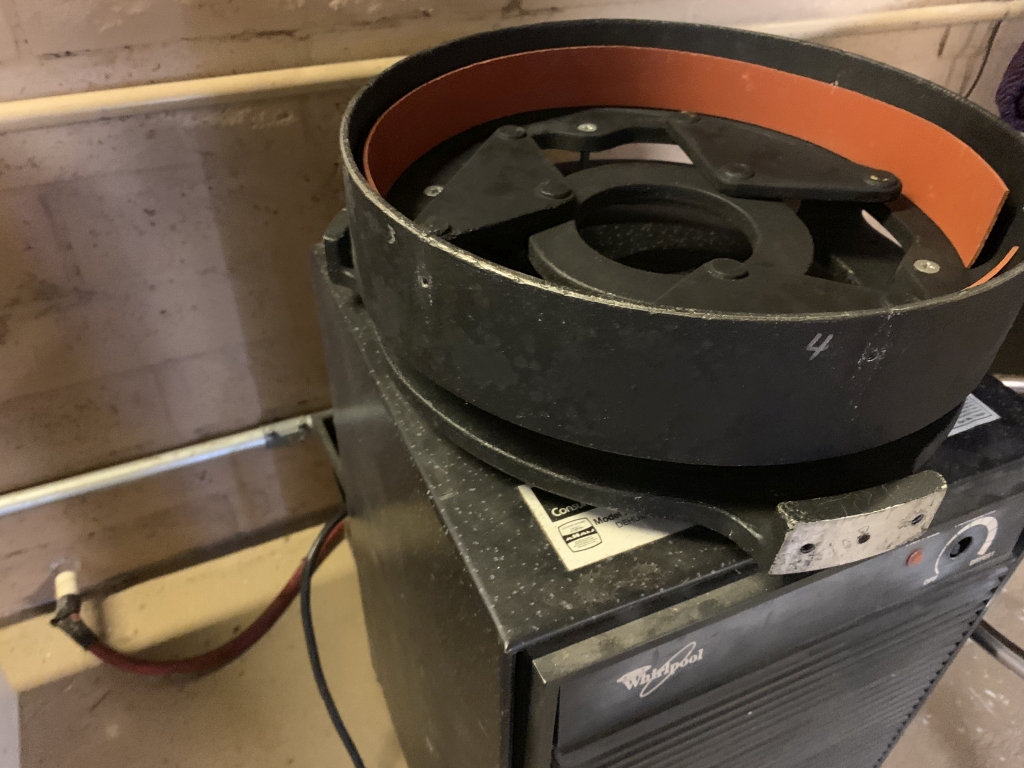
And here is the mirror cell. While it is not strictly necessary, I prefer to be able to reassemble it exactly as it was disassembled. Here, I've labeled the screw holes based on which mirror retaining clip came from which hole.

Here are the previously mentioned mirror clips, numbered to match their place on the mirror cell. Again, not really necessary, but I prefer to do it this way.

Here's the mirror. In the pictures, it looks dirtier than it did in person.
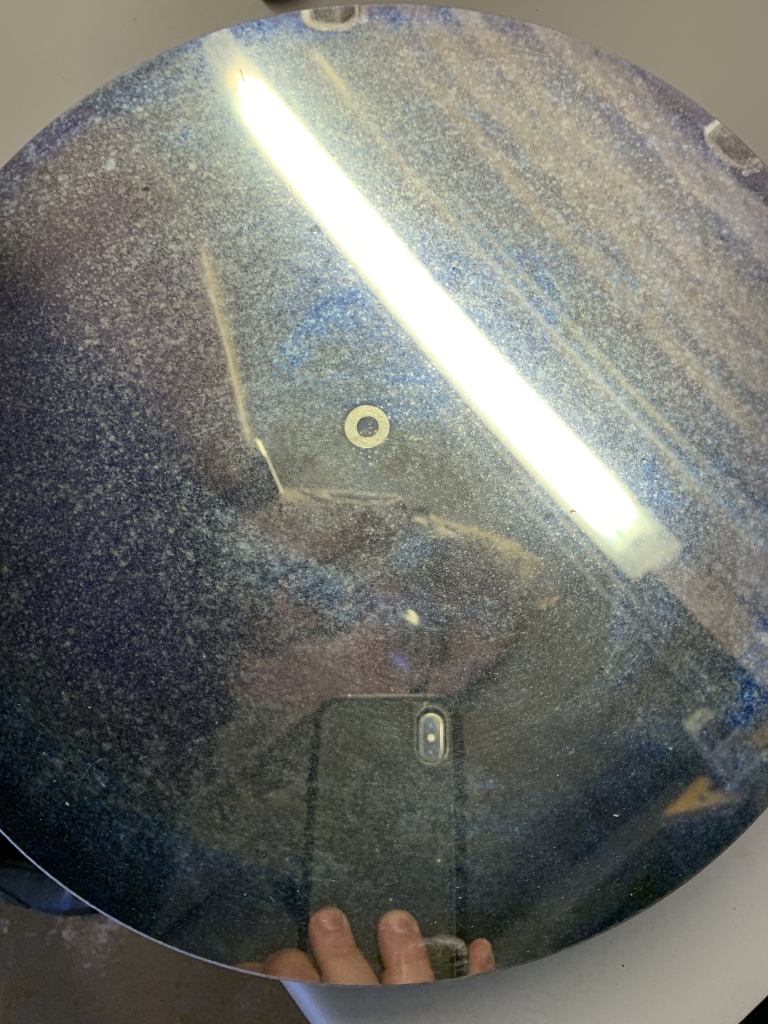
Ok, maybe it was pretty dirty. Though, as dirty as it may look, it actually performed fairly well.

Here I'm doing a rinse on the mirror with a slow flow of water. You do NOT want to touch the surface if you don't have to.
Conventional mirrors, like your car's rear-view mirror or your bathroom mirror have the reflective coating on the back-side of the glass. But the whole point of an astronomical mirror is so that the light does not have to pass through glass, which causes chromatic aberration. For astronomical mirrors, the reflective coating is on the front-facing surface. If you touch it, you can damage the coating, which is usually only a few molecules thick.
To clean it, then, the best way is to run water over the mirror slowly and gently to rinse off any dirt or dust. Sometimes, if it's really bad, you might use a very mild dish soap and run the water longer. Only if there's something really, really badly stuck on the surface would you consider touching the surface. We had a mud dauber wasp build a nest on one of the Dobsonian scopes we have available at the dark site for members to borrow. For that one, the member who did the cleaning had to do a little extra work to get the nest and its residue off. For that, cotton balls soaked in distilled water and run carefully from the center outward are the safest bet.
But this should only be done sparingly. And even then, it might not be necessary. Small flaws in the mirror aren't all that important. For example, the 107 inch Harlan J. Smith telescope at the McDonald Observatory was damaged 50 years ago when an employee of the observatory went nuts and fired 5 shots into the mirror (after firing one into his boss). After being checked out, the mirror was put into service with the five bullet holes in the surface. The impact of the cratering from the rounds has reduced the effective light gathering ability of the mirror by less than 1%. So if you're cleaning a telescope mirror and can't easily get a few spots off, it's nothing to be too concerned with.
On a similar note, after cleaning a 10 inch mirror of my own once, I attempted to mark the center (which is necessary for proper alignment of the mirrors). I normally use a grease pencil, but couldn't find mine, so I decided to use a dry erase marker. This was a BAD idea, because little did I know it, but the ink in a dry-erase marker can dissolve the optical coating. I started noticing what looked like scratches in the surface after a few small marks and then realized what happened. I was left with a spot in the mirror about the size of a quarter without a lot of optical coating. When I tried using the mirror after this, I really didn't notice much, if any, difference.
So the moral of the story is not to worry about small stuff on the mirror, it won't have much affect. Also, don't be a dumb-ass like me and use a dry-erase marker to center-dot the mirror.
Ok, so once you've cleaned the mirror, give it a good rinse with distilled water. In the case of this mirror, I used a full 1 gallon jug of distilled water. Why distilled? it doesn't have anything in it, so when it dries it shouldn't leave spots. Use it to rinse off the tap water which MIGHT have stuff in it. Rinse thoroughly and you shouldn't have any spots.

Once the mirror is rinsed clean, it's time to dry it. Here I've propped the mirror up on its side, so all water slides down and off (if you dry it laying flat, dust in the air could settle on it and end up creating some spots.
In this case, I'm using an hair dryer to speed up the process. If you do this, you want to blow across the mirror, not directly on it, and use no heat or low heat and a low fan setting. Also, don't hold it too close... you mostly just want warm, dry air flowing over it to help speed up the process. And make sure the mirror won't roll away.
Do NOT dry the surface of the mirror with paper towels or anything else - not even a microfiber cloth. Scratches are a possibility, but the bigger problem is damaging the optical coating.
Sometimes the coating can start to come loose in spots. If you touch the mirror in those spots, you could cause it to flake away, and it can potentially take more with it. Bottom line: unless you absolutely have to, don't touch the surface at all.
Ok, once the mirror is dry, time to reassemble.

You saw the before pictures, here's an after pic. Quite an improvement.
I didn't take any pics of the reassembly... but basically you reassemble in reverse order of disassembly. Again, I like to put it back just as it was, minus the dirt/dust on the mirror.
Once reassembled, you then need to collimate it. Collimation is the proper alignment of the mirrors. If you reassembled just the way it was disassembled, it's possible (though not a given) that it may not take as much adjustment to get it back to collimation (then again, it might... but, to me, its worth the minor effort).
And then, you're back in battery and ready to observe.
And that's it. Clear skies!
hezroncarverofgravenimages
woodlol
HumanFromPlanetEarth
Imgur needs more of these type posts
supervillainsevilmoustache
The bit about an observatory guy shooting up the place was completely unexpected
henryv1598
Yeah, you don't hear much about astronomers losing it. I think he was actually a maintenance tech, but still, not what you'd expect.
Raggedsrage
How much would it cost to recoat the mirror?
henryv1598
Depending on options, probably a couple hundred or so. It’s not outrageously expensive, but not something you want to if you don’t have to
henryv1598
It’s also a nuisance and usually takes a few weeks, during which the scope is useless.
Raggedsrage
Ok so not the end of the telescope but something to take time and care to avoid.
henryv1598
Correct. Even if the mirror is damaged to the point of not being usable, it can be replaced. For a scope like this that would be 1/2
henryv1598
Worthwhile. For some scopes, replacement is more practical. Depends on the scope. 2/2