
Disclaimered

4766

174

6

0. You may already know this one, but just in case: The speed of "one light second" is 186,282 miles. One Light year is 5,878,499,810,000 miles (approx 6 Trillion miles) or 9,460,528,400,000 kilometers.

1. All humans have the ability to see ultraviolet light, but it is passively filtered out by the eye’s lens. Patients who undergo surgery to remove the lens can detect ultraviolet light.
https://www.theguardian.com/science/2002/may/30/medicalscience.research

2. In 1999, Harvard physicist Lene Hau was able to slow down light to 17 meters per second and in 2001, was able to stop light completely.
https://www.theguardian.com/science/2002/may/30/medicalscience.research
https://en.wikipedia.org/wiki/Lene_Hau

3. Some areas in Scotland and Japan switched to blue street lights at night and saw a decrease in crime and suicide rates.
https://psychcentral.com/blog/archives/2008/12/13/can-blue-colored-light-prevent-suicide/

4. LED traffic lights have led to car crashes and deaths in the past, since they emit too little heat to melt snow & ice, which blocks the lights.
http://abcnews.go.com/GMA/ConsumerNews/led-traffic-lights-unusual-potentially-deadly-winter-problem/story?id=9506449

5. According to English law, the “Right to light” states that the owner of a building with windows who has received natural daylight for 20 years or more is entitled to forbid any construction or other obstruction that would deprive him or her of that illumination.
https://en.wikipedia.org/wiki/Right_to_light

6. A team of developers are taking the glow in the dark enzyme that is found in species of jellyfish and fireflies and are creating bio-luminescent trees. These trees can potentially light up public streets while being energy-neutral.
http://www.huffingtonpost.com/2014/03/30/daan-roosegaarde_n_5044578.html

7. Supersonic aircraft or bullets produce sonic boom when waves generated by the supersonic body propagate at the speed of sound itself. Similarly for light, a blue glow is emitted when something travels faster than the speed of light moving through a medium (so light is slowed down). This is known as Cherenkov radiation.
https://en.wikipedia.org/wiki/Cherenkov_radiation

8. While in space astronauts sometimes see random flashes of light caused by cosmic rays hitting the optic nerve. We don’t see it on earth because the magnetosphere protects us from the rays.
https://alteaspace.wordpress.com/2011/11/01/the-effects-of-cosmic-rays-on-astronauts-the-light-flash-phenomenon/

9. The blinking light atop the Capitol Records Tower spells out the word “Hollywood” in Morse code, and has done so since the building’s opening in 1956.
https://en.wikipedia.org/wiki/Capitol_Records_Building

10. Betelgeuse is a massive star 450 light years away that may go supernova any time between now and 300,000 years and will outshine the moon at night and be clearly visible during the day.
http://earthsky.org/brightest-stars/betelgeuse-will-explode-someday

11. Humans are bio-luminescent. However, the light emitted by our body is 1000 times weaker than our eyes can pick up.
http://journals.plos.org/plosone/article?id=10.1371/journal.pone.0006256

12. Peacock feathers are actually brown, but have microscopic structures that interfere with light that make the bright iridescence.
https://en.wikipedia.org/wiki/Structural_coloration

13. Ordinary Pressure-sensitive tape (“Scotch tape”) displays a glowing line where the end of the tape is being pulled away from the roll. It can be seen in the dark.
http://www.nature.com/news/2008/081022/full/news.2008.1185.html

14. There is a deep sea fish named Stoplight Loosejaw that takes advantage of the fact that fish can’t see red light, and illuminates its prey with a beam of red bioluminescence so it can hunt with an effectively invisible beam of light.
https://en.wikipedia.org/wiki/Stoplight_loosejaw

15. The element Selenium conducts electricity only when a light is shined on it. In the dark, it is an insulator.
https://en.wikipedia.org/wiki/Selenium

16. An estimated one-third of the population will often sneeze when looking at the sun or a bright source of light. This is due to a genetic quirk known as the photic sneeze reflex; a condition described by neurologists as having to do with crossed wires in the brain.
https://www.scientificamerican.com/article/looking-at-the-sun-can-trigger-a-sneeze/

17. East and West Germany division can still be seen from space, each side using different types of light bulbs.
http://camyx.com/fun/2013/04/east-west-germany-division-seen-from-space/

18. Due to time dilation one could travel thousands of light years in a single human lifespan without exceeding the speed of light.
https://en.wikipedia.org/wiki/Special_relativity
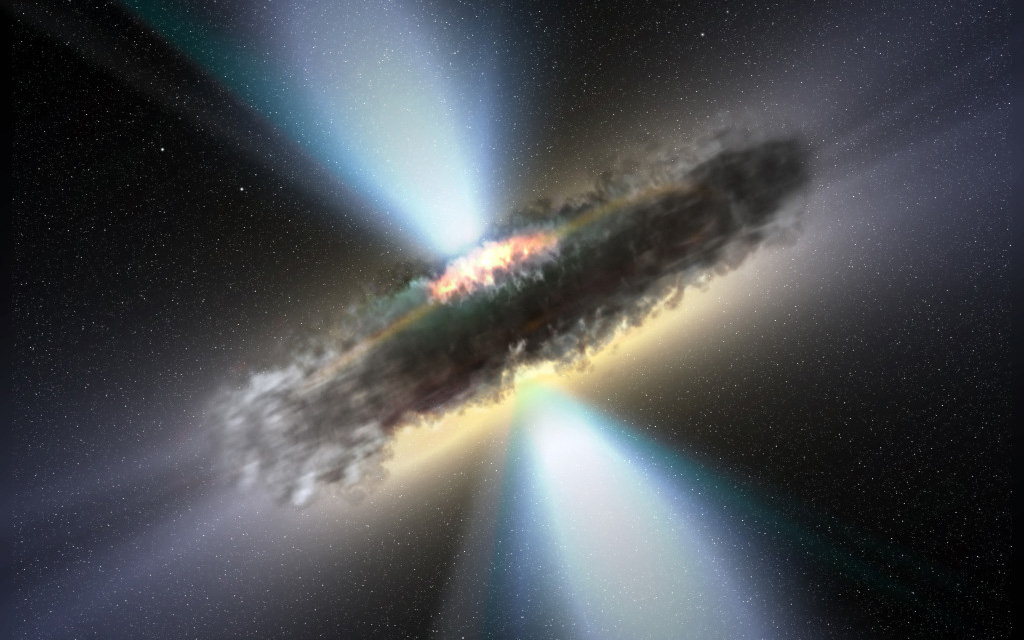
19. "S5 0014+81", the biggest super-massive black hole known, is so bright due to its huge event horizon that if it were 100 light years away from Earth (6.31 billion times more distant than the Sun), it would appear just as bright as our host star.
https://en.wikipedia.org/wiki/S5_0014%2B81

20. Tachyons (hypothetical particles that travel faster than light) would experience time in reverse. They would have imaginary mass - as in square root of -1. Adding kinetic energy would slow them down; an infinite amount of energy would be needed to slow them to the speed of light.
http://www.armaghplanet.com/blog/what-ever-happened-to-tachyons.html
Spoderm80
This post made me feel enlightned.
BobRossHB
#4 why not just add an after market clear plastic disk to the lamp, could even make it that reflector grid if it helped
EyesLikeTheSky
Tachyons are a thought experiment they are not actually predicted to exist
supergeer
Brilliant
magnetoffridges
I like doing a bit of light reading.
CWadeFromDowntown
I will hurt you for this
Paradoxroutine
I just reported you.
reflectedsoundofundergroundspirits
No. Tachyons are science fiction. To accelerate anything to C that has mass would require infinite energy and would have infinite mass. >
reflectedsoundofundergroundspirits
>> impossible to observe.
Disclaimered
Yes like it says... hypothetical particles. Assuming also they have no mass or perhaps negative mass if there is such a thing.
reflectedsoundofundergroundspirits
> However, it is true that anything traveling faster than C would move backwards in time, superluminal particles would be nearly >>
ThisIsANewName
"The speed of "one light second" is 186,282 miles."
CaffeineManic
Yeah, how about "the distance light travels in 1 second in a vacuum is 186,282 miles".
reflectedsoundofundergroundspirits
Per hour would be the rate but that is how it is determined--measure the distance light would travel per second*3600.